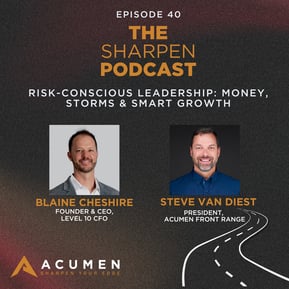
Meet Blaine Cheshire & Level 10 CFO
Blaine Cheshire is the Founder and CEO of Level 10 CFO, a fractional CFO advisory and outsourced accounting firm serving small to mid-market growth companies, typically in the B2B services and technology space.
Based in Colorado (after growing up in Albuquerque), Blaine leads a growing firm while raising three kids with his wife, Emily.
The Story Behind “Level 10”
While the name has an allusion to EOS—and Level 10 CFO is an EOS company that loves serving EOS businesses—the deeper inspiration comes from Dungeons & Dragons.
In Dungeons & Dragons:
- A Level 10 spell is the highest form of magic.
- It requires both mastery and multiple wizards working together.
That’s the model at Level 10 CFO:
- Financial and accounting expertise
- Team-based execution
- “Wizards” working together to create results for clients
The Financial Mistake CEOs Make: Not Changing the Players
One of the most common issues Blaine sees in growing businesses is this:
CEOs fail to upgrade the finance and accounting function as the business grows.
In the early days:
- A pre-revenue or sub-$1M company might rely on a part-time or informal bookkeeper.
Five years later:
- Revenue may be 10x higher.
- Complexity has increased.
- But the same structure is still in place.
As revenue grows:
- Compliance requirements increase.
- Banks expect more sophistication.
- Financial leaks can occur.
- Strategic blind spots can develop.
“Mo money, mo problems.”
Without the right financial players on the field, businesses risk:
- Leaky P&Ls
- Compliance issues
- Poor debt decisions
- Even existential threats
Sometimes the pain triggers change. Sometimes the iceberg isn’t seen in time.
The “Revenue Fairy” & Magical Thinking
Blaine introduces the idea of the Revenue Fairy—a metaphor for magical thinking around revenue.
The Revenue Fairy appears when:
- Leaders assume revenue will happen because they want it to.
- A weak pipeline is treated as guaranteed revenue.
- Expenses aren’t right-sized because of “one big deal” that hasn’t closed.
- A new sales hire is expected to magically fix everything.
This kind of thinking:
- Distorts planning.
- Increases risk.
- Avoids hard decisions on expense structure.
The Revenue Fairy may look nice—but she causes problems.
CFOs Aren’t the “No” People — They’re Risk-Conscious
Steve raises the common perception that CFOs are “Debbie Downers” who just say no.
Blaine reframes the role:
“We’re not risk-averse. We’re risk-conscious.”
A strong CFO:
- Understands the strategic aims of the company.
- Quantifies the financial implications of decisions.
- Evaluates how much money is being put at risk.
The key question becomes:
- If this decision goes poorly, is it a missed opportunity—or business failure?
Financial leadership helps clarify:
- How big the bet is.
- What the downside looks like.
- Whether the business can survive the risk.
It’s not about eliminating risk—it’s about understanding it.
Wisdom Over Knowledge
Steve highlights the distinction between knowledge and wisdom.
Many business owners:
- Have financial knowledge.
- Have peer advice.
- Have experience.
But wisdom requires:
- Application.
- Perspective.
- Strategic integration.
That’s the role of financial leadership at a higher level—turning information into wise decision-making.
Leadership Through a Personal Storm
Over the past two years, Blaine and his family walked through significant cancer challenges. While the outcome is positive and his family is healthy, the experience reshaped his perspective.
Key lessons from that season:
1. Be Intentional With Time
Life is uncertain. Leaders must:
- Take stock of how they spend their time.
- Be intentional about family and priorities.
- Avoid waiting for “someday.”
2. Build a Business That Runs Without You
If the CEO is in the middle of everything:
- A personal crisis becomes a business crisis.
If structure and leadership are distributed:
- The company can continue functioning.
Blaine credits:
- His partner, Zach.
- His leadership team.
- A strong company structure.
Because of that, he was able to focus on family without the business collapsing.
The Fractional CFO Model
For companies in the $2M–$20M range, a full-time CFO may not be feasible.
The fractional model provides:
- A portion of CFO-level strategic leadership.
- Controller oversight.
- Tactical bookkeeping and accounting support.
As the business grows:
- The fractions adjust.
- The financial structure scales with the company.
It’s about putting the right players on the field—at the right size—for the stage of growth.
Living Now, Not “Someday”
Blaine recently took his family to the Philippines for nearly three weeks:
- Visiting his accounting team (based there).
- Spending intentional time with family.
- Experiencing culture and connection.
He shares the importance of:
- Not postponing life until retirement.
- Building teams that allow leaders to step away.
- Creating margin.
At Level 10 CFO, team members receive a paid sabbatical after five years—reflecting the belief that work should support life, not consume it.
Acumen & Iron Sharpening Iron
Blaine shares that his Acumen experience has been impactful:
- Strong peer council.
- Meaningful relationships.
- Growth through shared leadership.
- “Iron sharpens iron.”
Acumen supports CEOs in:
- Growing their businesses.
- Being challenged.
- Staying aligned with faith, family, and purpose.
Connect
This episode brings together financial clarity, leadership structure, and personal resilience—reminding CEOs that growth requires both wisdom and intentional living.